top of page
Search

#5. We're All Blind


Post #4 discussed an absolutely amazing optical illusion. Here, we’ll take a somewhat deeper dive into the meaning and general importance of misjudgments—of which optical illusions are but one kind. But just for fun, let’s have a quick glance at another one.
ree

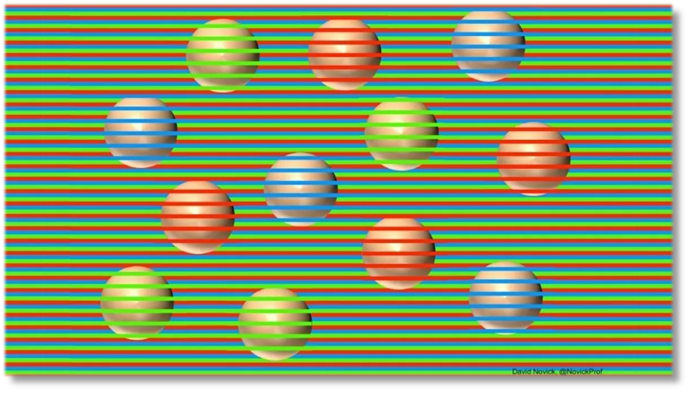
How many spheres of each color do you see, hovering up there like UFOs behind venetian blinds?
 
Virtually everyone gets this wrong, unless they’re color blind or suspicious of my little demonstrations. My eyes are certainly fooled by it, despite knowing the correct answer. Like you, I see four spheres of each color, red, green, and blue.
 
Our eyes and brains are betraying us. The correct answer is right there in front of our eyes, but we don’t see it: All twelve spheres are beige. You can verify this for yourself by zooming into the image and looking between the lines.
 
It’s the horizontal lines that throw us off. The color of the lines when they cross a sphere determines its apparent color. Eliminating the lines neutralizes the effect.
 
This is called an assimilation effect. Our brains deceive us by unconsciously “assimilating” the colored lines into the coloring of the sphere.
 
This kind of visual anomaly serves as a metaphor for many judgments that life confronts us with. Sometimes the obvious answer is the correct one. Other times, something about the problem is terribly misleading and we’re helpless but to get it wrong. You should take some comfort in the fact that, for any given judgment error you might make, there are likely billions of other people who’d make the identical error under the same circumstances.
 
What We Don’t See
 
Let’s look into light.
 
Vision begins with light waves entering our eyes. No light, no sight. Light is a type of electromagnetic radiation that either emanates from a source, such as the sun or a light bulb, or bounces off other objects before entering our eyes.
 
Visible light shares the electromagnetic spectrum with other forms of radiation. To one side are gamma rays, X-rays, and ultraviolet rays. On the other side, infrared radiation, microwaves, and radio waves. Various devices can detect waves all across the spectrum, including regular cameras that “see” the slice of radiation visible to our eyes. But how substantial is that visible slice?
 
Not very. Imagine that you, some friends, and a one-pound bag of shelled peanuts gather on a Saturday night to stream The Shawshank Redemption. Before Andy escapes from the prison, you’ve devoured all the peanuts except for one-fifth of one nut’s worth of crumbs at the bottom of the bag. You’d probably feel comfortable saying the bag is empty.
 
The crumbs are to the full bag of peanuts as visible light is to the full electromagnetic spectrum. We are as blind as the bag is empty.
 
It would be world-changing if only we could see more wavelengths. We could have Superman’s X-ray vision, or modern telescopes’ ability to see infrared radiation or radio waves. But evolution selects for what works, not for what’s awesome. We see what we need to see to survive long enough to procreate and forestall our extinction for at least one more generation.
 
Despite the limitations, what little we can see includes all the colors of the rainbow, plus a limitless array of lit-up objects signalling their presence to our brains. Like vision itself, our ability to sense colors is also a product of evolution. The color spectrum coincides with the most energetic range of the sun’s electromagnetic output, and being able to sense it confers survival advantages.
 
By now you’re surely asking yourself, “I wonder if different stars emit different light spectra?” Maybe that’s just me asking. Anyway, the output of other stars does indeed differ from our sun’s depending on surface temperature, age, and other factors. If our sun had emitted a different range of electromagnetic frequencies over the last couple of million years, we’d most likely have evolved to see things quite differently.

Through a Lens Wrongly
 
Vision. The Emperor of All Senses. We give it little thought as we navigate the world. We drive between the lines, push the right elevator buttons, and locate the handles of our refrigerator doors. We also read about faraway people and places, and might even pay them a visit for a firsthand look.
 
Ninety-nine percent of us are well-sighted according to the legal definition. That is to say, we see things clearly from twenty feet away that a “normal” person sees from up to two hundred feet. Seems like a low bar. Do not think about it when you’re cruising down an unlit two-lane at night and spot oncoming headlights.
 
Within the realm of what we can see, the throughline from light waves to visual experience is profoundly convoluted. For vision to function, our eyes and brains must channel a tsunami of electromagnetic waves into a meaningful trickle of nerve impulses. (Here’s a nice intro to how it works.) By force of habit, we take this process entirely for granted, surviving most days without major visual incident.
 
Why Does it Matter?
 
Problems arise in judgment settings that are either novel, masquerading as familiar, or both. The image of the colored spheres behind the horizontal lines was a great example of this: Novel, but composed of simple, familiar objects.

We’ve seen how an assimilation bias in an optical illusion can lead to an erroneous judgment. Furthermore, judgment errors can lead to faulty decisions in all areas of life, including economic, health-related, financial, political, and social. Stereotyping, for example, is a kind of shared judgment bias with especially destructive social consequences.
 
What’s so troubling about this is that, although we can test for bias and prove it occurs, nobody feels they’re being biased while it’s happening.
 
I’ll illustrate this with an example from my own research, which shows how the assimilation effect biases judgments about fair compensation.
  
One study looked at judgments about fair rewards. Some of the respondents read a vignette describing how a witness to a rape contacted police, leading to the perpetrator’s conviction. The victim’s family, the Smiths, decided to set up a fund to reward witnesses. The vignette continued:  
 
The Smiths decided that the rewards should correspond to the seriousness of the crimes. While trying to decide how much to reward people who report rapes, they learned that a family in another state recently paid a reward of $50,000 to a young witness in a case much like their daughter’s.
 
The Smiths believed that $50,000 was too large a reward for a witness to a rape case.
 
Then respondents were asked the big question:
 
If you were the one who had to decide, based on the information given to you, how much of a reward do you think would be appropriate? $______
 
The average response was around $20,000. By itself, this tells us nothing about possible bias. But compare it to the result from a second version of the vignette given to a different group:  
 
… a family in another state recently paid a reward of $15 to a young witness in a case much like their daughter’s.
 
The Smiths believed that $15 was too low a reward for a witness to a rape case.
 
How much did respondents in this group deem to be a fair reward? About $500, which is over ninety-seven percent less than the other group.
 
This is powerful evidence that the fair reward estimates in both versions assimilated toward amounts deemed to be too high and too low, much the way the spheres’ apparent colors assimilated toward the colors of the seemingly irrelevant horizontal lines.
 
 
We can’t hope to rid the world of perceptual biases. But there are ways to help contain them. Awareness is the first step. If the perception is relevant to an important judgment, know that others have almost certainly studied similar cases. But you’ll have to dig a little.
 
For example, there’s a robust literature debunking UFO interpretations of lights in the sky, and a parallel stream of work debunking apparitions wafting through parlors and bedrooms. Before jumping to conclusions, consider alternative explanations for what might appear to have been alien spaceships, ghosts, or ghosts in alien spaceships.
 
Other areas of research have investigated how we use mental shortcuts and logical fallacies in ways that lead us astray.
 
 
We live in a culture that legitimizes making important decisions based on what we feel in our “guts.” For example, I can think of more than one U.S. President in my adult lifetime who was a proud non-critical thinker and touted the value of making shoot-from-the-hip decisions. Such decisions rarely work out well.
 
In many situations, our gut feelings are all we’ve got. Often enough, that’s fine. But in some situations, where perceptions, judgments, and decisions really matter, it’s worth keeping in mind that our guts are oftentimes dumber than a sack of hammers, and there are ways we can do much better.
 
 
If you enjoyed reading this, please share it with friends and on your social media of choice.


Recent Posts

See All
#8. Pale Blue Walls

My earliest interest in cutting-edge science was mainly in evolutionary biology. As a high schooler, I watched National Geographic TV specials about archaeologist Louis Leakey, who unearthed the remai


#7. What Do You Mean?

We recently lost the wonderful Diane Keaton, perhaps best known for her portrayal of Annie Hall in the film of the same name. There’s a funny scene in the movie that’s relevant to this post. In it, An


Comments


© 2025 by Barry Markovsky. Powered and secured by Wix
bottom of page